Joints in Human Body (Short).
Introduction:
-
A joint is the place in the body where bones of the skeleton meet.
-
It is also called “Articulation.”
-
Joints allow locomotion.
Classification of Joints:
-
Joints can be classified as structurally or functionally.
-
The structural classification of joints depends on the manner in which the bones connect to each other.
-
The functional classification of joints depends on the nature of the movement the joints allow.
-
Arthrology is the branch of science that deals with the study of joints it is also called “Synosteology”.
Structural Classification of Joints:
-
The structural classification of joints is based on the type of tissue that binds the bones to each other at the joint.
-
There are three types of joints in the structural classification.
-
Fibrous,
-
Cartilaginous,
-
Synovial joints.
-
Fibrous Joints:
-
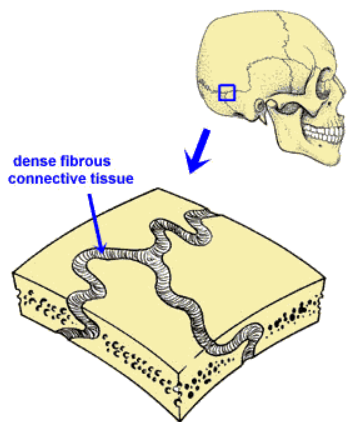
These are joints in which bones are joined by dense connective tissue that is rich in collagen fibers.
-
These joints are also called sutures.
-
The joints between bones of the cranium are fibrous joints.
-
Cartilaginous Joints:
-
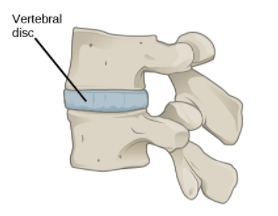
Cartilaginous joints are joints in which bones are joined by cartilage.
-
The joints between most of the vertebrae in the spine are cartilaginous joints.
-
Synovial joints:
-
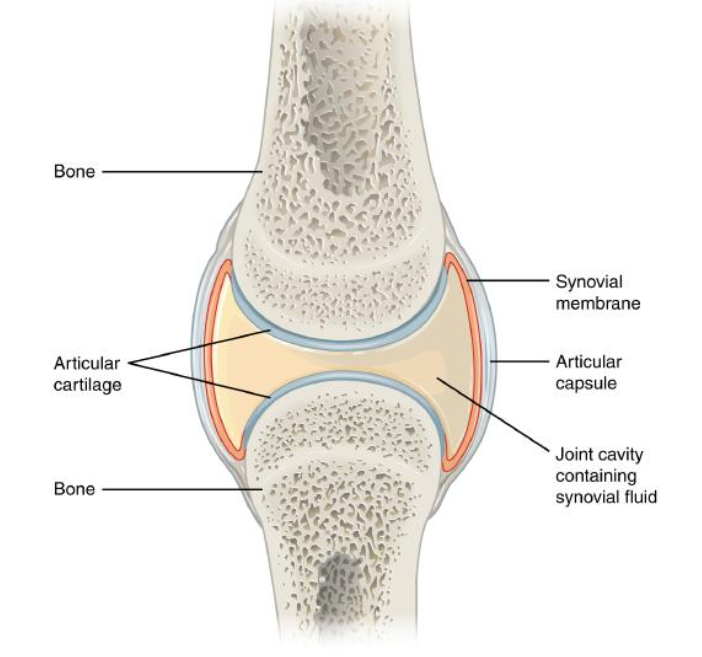
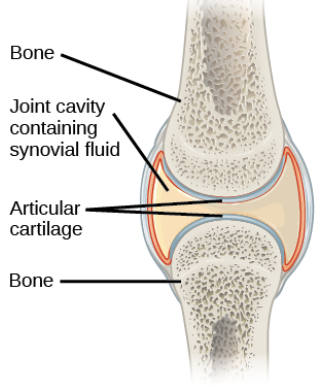
Synovial joints are characterized by a fluid-filled space, called a synovial cavity, between the bones of the joints.
-
The cavity is enclosed by a membrane and filled with a fluid, called the synovial fluid, which provides extra cushioning to the ends of the bones.
-
Cartilage covers the articulating surfaces of the two bones, but the bones are actually held together by ligaments.
-
E.g. Knee joint.
Types of Synovial Joints:
-
There are different types of synovial joints that offer different kinds of movements and articulations.
-
Gliding joint.
-
Hinge Joint.
-
Pivot Joint.
-
Condyloid Joint.
-
Saddle Joint.
-
Ball & Socket Joint.
-
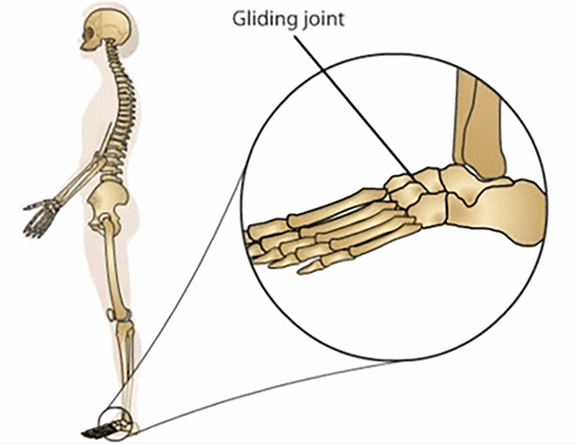
Gliding joint:
-
Also called “Planar Joints”.
-
The articulating surfaces are flat or slightly curved.
-
This joint allows side to side and back and forth movements between the flat surfaces of the bones.
-
e.g
-
Intercarpal joints.
-
Intertarsal joints.
-
Sternoclavicular joints.
-
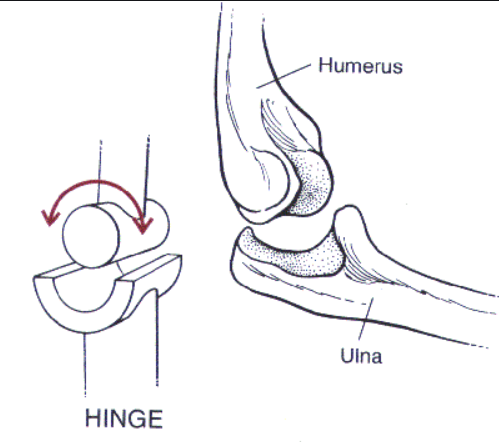
Hinge Joint:
-
This joint allows an angular opening and closing motion.
-
One bone remains stationary while the other bone moves in an axis.
-
The convex surface of one bone fits in the concave surface of another bone.
-
They are monoaxial; they allow movement in only one direction.
-
e.g.
-
Knee joint.
-
Elbow joint.
-
Ankle joint.
-
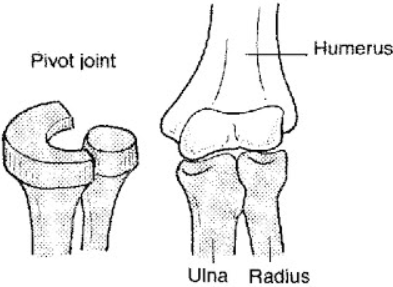
Pivot Joint:
-
The rounded or pointed surface of one bone articulates with the ring formed by another bone.
-
This monoaxial allows movement in only the longitudinal axis.
-
e.g
-
Atlanto-axial joint: Between Atlas and axis which permits side to side rotation of the head.
-
Radioulnar joints which permit anterior and posterior movements of the palms.
-
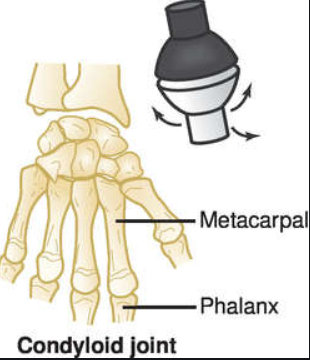
Condyloid Joint:
-
Also called “ellipsoidal Joint”.
-
Here in this joint convex- oval shaped projection of one bone fits in the oval shaped depression of another bone.
-
Biaxial joint; movement is permitted in around two axis.
-
e.g.
-
Wrist joint.
-
Metacarpo-phalangeal joints.
-
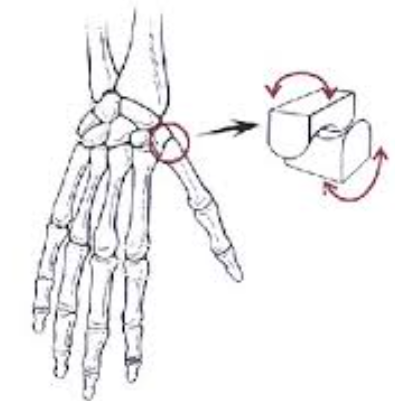
Saddle Joint:
-
As the name indicates, the articulating surface of one bone is saddle shaped and the articular surface of another bone fifties in the saddle.
-
It is a modified condyloid joint.
-
Triaxial; allows movements in three axes.
-
e.g Carpometacarpal joint between Carpal bone: Trapezium and metacarpal of the thumb.
-
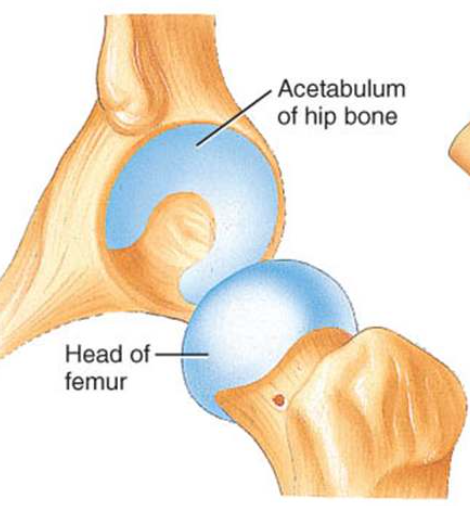
Ball & Socket Joint:
-
Here in this joint the ball-like articulating surface of one bone fits in a cup like depression of another articulating bone.
-
Triaxial; allows movements in three axes.
-
e.g.
-
Shoulder Joint. (The head of Humerus fits in the glenoid cavity of the scapula.)
-
Hip Joint (head of femur fits in the acetabulum cavity of the hip bone.)
Commonly Asked Questions:
-
Define and classify joints.
-
Describe the structure of a typical synovial joint.
-
Classify and describe different types of joints.
-
Write a note on,
-
Fibrous joints.
-
Ball and socket joints.
-
Pivot Joints.
-
Gliding Joints.
-
Synovial joints.